|
Biography St Teresa Avila
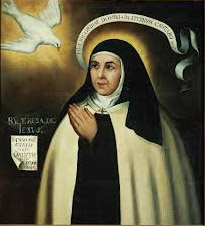 St
Teresa of Avila (Teresa de Cepeda y Ahumada) was born in Avila,
Spain on 28th March 1515. Her parents were both pious Catholics
and in some ways inspired their daughter to take up a life of
prayer. As a young child Teresa showed signs of a deeply
religious nature; she would often retreat into silence for
prayer and would enjoy giving alms to the poor. She was very
close to her Mother, who provided a warm counterbalance, to the
strictness of her father. However in her teens, Teresa’s mother
passed away, leaving the young Teresa distraught at the void she
felt. The young St Teresa tells of her despair and how she
turned instinctively to the Virgin Mary for comfort.
"I threw myself down in despair before an image of the Mother
of God. With many tears, I implored the Holy Virgin to become my
mother now. Uttered with the simplicity of a child, this prayer
was heard. From that hour on, I never prayed to the Virgin in
vain."
During her later teen years Avila lost some of her early piety
and religious zeal. She recounted how she became interested in
worldly matters and enjoyed the company of a wide circle of
friends. She had a natural charm and found it easy to make
friends. In return she enjoyed the compliments and friendships
of others. However, she was not at peace, considering herself to
be a miserable sinner; later she would look back in guilt at her
early life. However this sense of being a “miserable sinner” was
probably the result of a harsh self-judgement, encouraged by her
fathers exacting religious standards. At the age of 16, her
father decided to send Teresa to a convent school to be
educated. This re ignited in Avila an interest in following a
spiritual life and after some deliberation resolved to become a
nun of the Carmellite Order. At the time the convent rules were
not very strict; it was probably more relaxed than living with
her father. At the time the convent accepted many people into
the order, often for financial reasons. The convent became
overcrowded and people were often judged not on the basis of
spiritual intensity but on material possessions. In this climate
Teresa struggled to find time for quite reflection; although she
did start teaching people on the virtues of mental prayer.
Shortly after becoming a nun, Avila experienced a severe illness
(malaria), which left her in great pain for a long period. At
one point it was feared that her illness was so severe that she
would not be able to recover. However during this period of
intense physical pain, she began to increasingly experience
divine visions and an inner sense of peace. These inner
experiences of joy and peace seemed to transcend the intense
physical pain of the body. She describes in her own words her
state of mind during these trials and tribulations
“I bore these sufferings with great composure, in fact with joy,
except at first when the pain was too severe. What followed
seemed to hurt less. I was completely surrendered to the will of
God even if he intended to burden me like this forever..... The
other sisters wondered at my God-given patience. Without him I
truly could not have borne so much with so much joy.”
When she was a little better she resumed her prayers with
renewed vigour. However on telling others of her visions and
spiritual experiences she was dissuaded from persuading them.
Certain clergy felt they were just delusions of the devil. As a
result, for many years Teresa lost the confidence to pursue her
prayers and her spiritual life was almost put on hold. However,
when Teresa was 41, she met a Priest who convinced her to go
back to her prayers and implore God to come back. Initially, she
had some difficulty sitting through prayers. She wryly remarked
the end of the hour’s prayer couldn’t come soon enough. However,
in the course of time, she became absorbed in deep contemplation
in which she felt an ever growing sense of oneness with God. At
times she felt overwhelmed with divine love. The experiences
were so transforming, she at times felt the illumining grace of
God would wash her soul away. She was so filled with divine
contemplation it is said at times her body would spontaneously
levitate. Teresa, however was not keen on these public displays
of “miracles”. When she felt it happening she would ask other
nuns to sit on her to prevent her floating away.
Teresa was not a just a quiet, placid saint. She had an
endearing, natural quality; her life energy attracted and
inspired many who were close. They admired her for both her
outer charm and inner serenity. But at the same time her
religious ecstasies also caused jealousy and suspicions.
Unfortunately she was born into the period of the Spanish
inquisition, during this time any deviation from the orthodox
religious experience came under the strict observation and
scrutiny. On one occasion Teresa complained to God about her
mistreatment from so many different people. God replied to her
saying “That is how I always treat my friends” with good humour
St Teresa replied “That must be why you have so few friends”. St
Teresa struggled because there were few who could understand or
appreciate her inner ecstasies. However on the one hand she felt
these experiences to be more real than ordinary events.
At the age of 43 St Teresa decided she wanted to found a new
order recommitting to the values of poverty and simplicity. She
wanted to move away from her present convent which made a life
of prayer more difficult. Initially her aims were greeted with
widespread opposition from within the town of Avila. However,
with the support of some Priests, the opposition waned and she
was allowed to set up her first convent. St Teresa proved to be
an influential leader and founder. She guided the nuns not just
through strict disciplines, but also through the power of love,
and common sense. Her way was not the way of rigid asceticism
and self denial. Although she underwent many tribulations
herself, to others she stressed the importance of experiencing
God’s love. As she herself says:
“You know, I no longer govern in the way I used to. Love does
everything. I am not sure if that is because no one gives me
cause to reprove her, or because I have discovered that things
go better in that way."
“The important thing is not to think much but to love much and
so do that which best stirs you to love. Love is not great
delight but desire to please God in everything."
St Teresa devoted much of the rest of her life to travelling
around Spain setting up new convents based along the ancient
monastic traditions. Her travels and work were not always
greeted with enthusiasm, many resented her reforms and the
implied criticism of existing religious orders. She often met
with criticism including the papal nuncio who used the rather
descriptive phrase “a restless disobedient gadabout who has gone
about teaching as though she were a professor" St Teresa also
had to frequently contend with difficult living conditions and
her frail health. However she never let these obstacles dissuade
her from her life’s task. She eventually died on October 4 at
the age of 67. A fellow sister describes the hours just before
the death of St Teresa.
“She remained in this position in prayer full of deep peace
and great repose. Occasionally she gave some outward sign of
surprise or amazement. But everything proceeded in great repose.
It seemed as if she were hearing a voice which she answered. Her
facial expression was so wondrously changed that it looked like
a celestial body to us. Thus immersed in prayer, happy and
smiling, she went out of this world into eternal life.”
St Teresa Avila was one of the great Christian mystics.
Overcoming physical ailments, she became fully absorbed in her
devoted to God. As Sri Chinmoy says:
“In Spain, Teresa of Avila offered to the world something
profoundly mystical. Her mystical experience is the most
successful culmination of the divine marriage between the
aspiring soul and the liberating Christ, and it is here that
man’s helpless crying will and God’s omnipotent all-fulfilling
Will embrace each other.”

Biography of St. Teresa of Avila
|
Highlights of
the Book of Life
|
Highlights of the Interior
Castle |
Quotes of
Teresa of Avila |
Teresa of Avila
- Outline of the Life
|
Organizing Committee
|
Programme List
|
Registration
Form |
How to Reach
|
Back |